

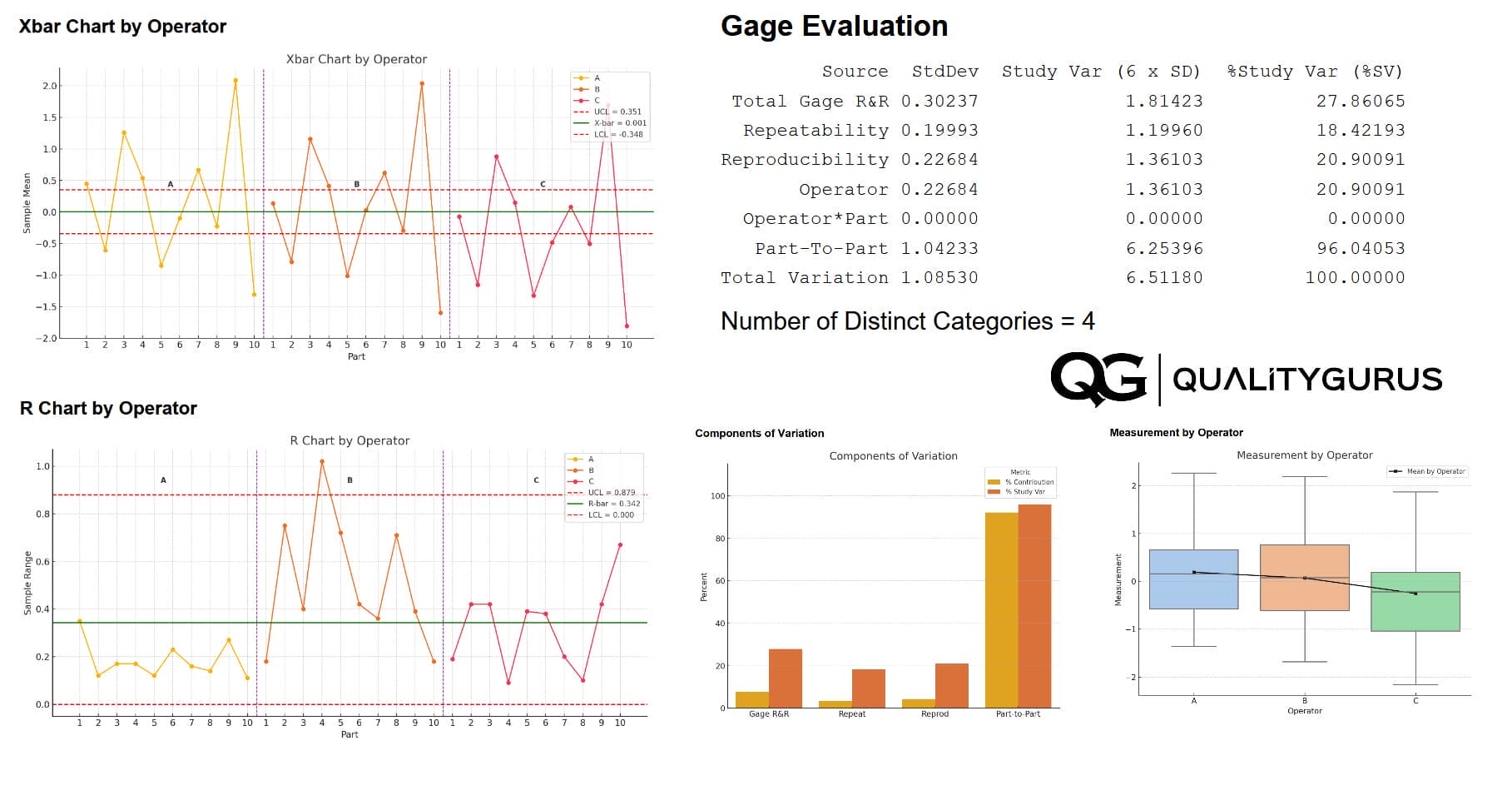
Measurement System Analysis (MSA) is a critical step in Six Sigma and quality improvement projects. Before we trust the data collected from any process, we need to ensure that our measurement system is reliable. One of the most common tools for this purpose is Gage Repeatability and Reproducibility (Gage R&R) analysis.
Traditionally, engineers rely on specialized statistical software like Minitab, JMP, or SigmaXL to perform these studies. However, with recent advances in AI, tools like ChatGPT can now assist in performing MSA, interpreting results, and even generating plots—providing a flexible and accessible alternative.
Case Study: Gage R&R with 10 Parts, 3 Operators, and 3 Replicates
In this case study, we conducted a standard crossed Gage R&R study:
- 10 parts were randomly selected from the process.
- 3 operators were chosen to represent typical measurement conditions.
- Each operator measured each part 3 times, giving us 90 measurements in total.
The data was entered into ChatGPT, and the analysis was run using an ANOVA-based Gage R&R method.
ANOVA Results
ChatGPT generated the two-way ANOVA results with and without operator-part interaction:
The Part-to-Part variation was significant (p < 0.001), showing that the study included a good spread of parts. Operator effect was also statistically significant, suggesting some reproducibility concerns. The interaction between operator and part was not significant, which allowed us to simplify the analysis.
Variance Components
The variance component analysis provided the breakdown of total variation into measurement system error and part-to-part variation.
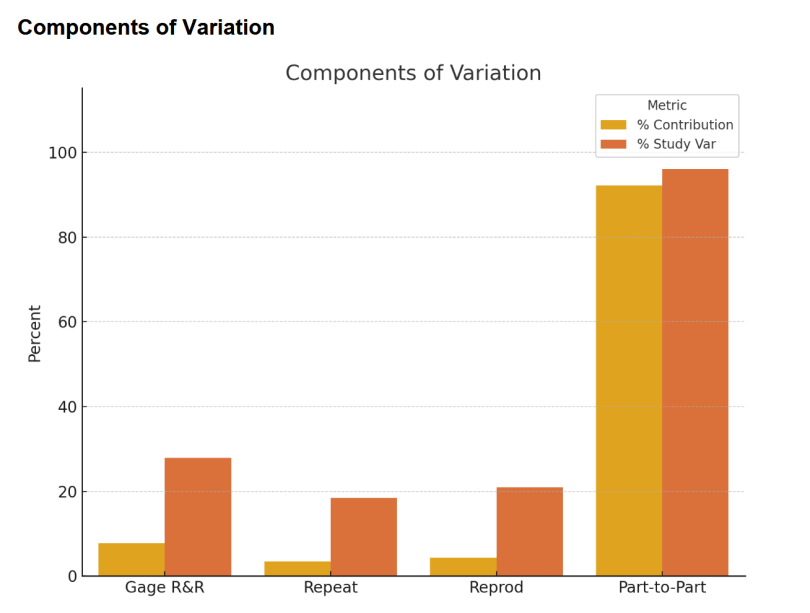
Key findings:
- Total Gage R&R contributed less than 10% of the total variation, which is generally considered acceptable.
- Repeatability (within-operator variation) was low, showing consistent measurements from each operator.
- Reproducibility (between-operator variation) contributed more variation, indicating calibration or training differences among operators.
Graphical Output
ChatGPT also produced visual outputs similar to industry-standard software:
- Components of Variation Plot
- R Chart and Xbar Chart by Operator
- Operator-by-Part Interaction Plot
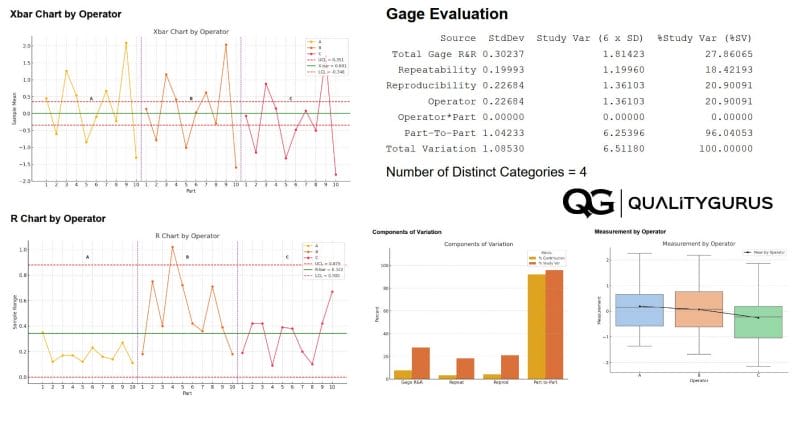
These plots provided clear evidence that the measurement system was capable, though operator differences should be addressed.
Why ChatGPT Matters for Quality Professionals
While traditional software will always be important, ChatGPT adds value in new ways:
- It combines statistical power with plain-language interpretation.
- It allows quality professionals to run analysis without expensive software licenses.
- It can be used for both technical analysis and communication, helping explain results to non-statistical audiences.
This makes ChatGPT not just a tool, but a partner in quality management and Six Sigma projects.
Next Step: Learn How to Use ChatGPT in Your Work
We have developed a suite of courses designed specifically for quality and Six Sigma professionals who want to integrate ChatGPT into their work. These courses cover practical applications such as:
- Using ChatGPT for Root Cause Analysis and structured 5 Whys
- Creating and interpreting quality tools and charts with AI assistance
- Building audit checklists and process maps with AI
- Performing Failure Modes and Effects Analysis (FMEA) with AI support
- Applying AI for Six Sigma projects, including data analysis and reporting
👉 Explore the full list of ChatGPT-based courses here: Quality Gurus AI-Powered Courses
By combining your quality expertise with the power of AI, you can take your career to the next level.